






‣ Robin's Songwriting Blog & News
|
Sun, Apr 14th, 2013 3:24 PM PDT
New! Songwriting VideoTue, Jan 1st, 2013 7:47 PM PST
Song Collaboration - Make it Work!I recently checked through the top five songs in the Rock, Country, AC, and Urban genres and, guess what… in all four genres at least four of the top five songs were collaborations. In the Country genre, all five were collaborations!
Collaborating has so many benefits that it’s worth putting some real effort into learning how to do it and finding compatible songwriting partners to work with. It may take some time, maybe a few false starts, but it can more than repay you in the long run. There are many reasons to collaborate: A collaborator can offer new ideas and nudge you out of old habits. If you fall in love with a line that isn’t working, a collaborator can point that out and keep the song moving forward. Working with a collaborator gives you added motivation, energy, and goals to meet. Chances are you’re stronger in one area (lyrics or music) than another; a collaborator can add strength where you’re weak. The cost of demoing your song can be half what it would be if you wrote it alone. So, why not collaborate? Do you resist collaborating because you’re afraid that you’re not good enough, or afraid you’ll come up with dumb ideas… or no ideas? I totally understand. We all share those fears. Here are a few ideas that can help you get past them. => Give yourselves a chance to warm up. Start by playing a few songwriting games together to loosen up. Take turns coming up with lines that rhyme, any rhyme. Make yourselves laugh. Play some of the songwriting games on my web site in the Songwriter’s Sandbox before you settle down to serious work. => Create plenty of raw material to work from. Start by suggesting titles to each other. Use a newspaper or magazine and find short phrases that appeal to both of you. Choose a phrase to work on and make a list of questions you might answer in the song. Then make lists of words and phrases that the title phrase suggests: images, actions words, associations, opposites, whatever strikes you. Create more material than you think you’ll need. Then, together, start assembling your chorus lyric. Try singing some of the phrases and start your melody. => Work long distance. You don’t have to be in the same room. Plenty of collaborations take place on the Internet. Organize folders and files so you can easily find mp3s and lyrics for each song you work on. Make sure it’s easy for you to receive music files. There are interesting sites like Dropbox that make it easy to share files. Use Skype for phone chats; it’s free and has better sound quality than a regular phone. => Swap songs. Work on more than one song at a time, so that each of you always has a song to work on. Trade songs every few days. => Give yourselves permission to do a job. Too often we think of songwriting as something we must be brilliant at all the time. It’s just a job, a hard job. Some days you do it better than others. Talk with your collaborator about experiences and expectations. WHERE TO FIND COLLABORATORS Clubs and music venues: You can find potential collaborators at clubs in your area. Try an open mic night. You’ll find singer-songwriters in a variety of styles. If you can, play a few songs of your own so people get a chance to hear what you can do. Local schools: Check out the music department at your local community college or university in your area. Post on the bulletin board or talk to a couple of teachers. Find out if there's a music club or open mic night on the campus and talk to a few people. Get to know who's doing what. You're likely to find some very talented musicians, songwriters, and people with home studios. Music stores: Many music stores offer lessons. Talk to the instructors to see if they can recommend a talented student or maybe the instructor will be interested! The Internet: You don’t have to limit yourself to songwriters in your area; the Internet makes long distance collaboration easy. Do your research. Look for established web sites with forums where songwriters meet to share songs, get feedback, and find collaborators. The Muse’s Muse web site has a good one. Click on “Songwriting Message Board.” Spend some time getting to know the regular contributors. Listen to their songs, read their lyrics, check out their melodies. When you find someone you think would make a good collaborator, go ahead and contact them. You can also check out the “Collaboration Corner” on TAXI’s forum Now, go find somebody to play with! (c) 2012 Robin Frederick Based on the book "Shortcuts to Hit Songwriting." Sat, Jun 9th, 2012 11:17 AM PDT
SONGWRITING HABITS: Make Them Work For You!Habits: We all have them. A good habit, like exercise or flossing, can be a big plus, helping you improve your life without even thinking about it. Bad habits - well, we all know what those are and we've all got 'em - can be a drag on your life and keep you from achieving your goals.
As in life, so in songwriting. There are good songwriting habits that can help you achieve your goals faster, and bad habits that can cause you to write the same unsuccessful song over and over. Have you ever noticed yourself falling into the same melody, chord, or lyric writing patterns in song after song? This is songwriting from habit. Often it means you're writing the first thing that occurs to you. It could be a chord progression or melody style you've heard over and over again in the music you grew up with. It became so ingrained that it now feels natural and spontaneous. Sometimes we mistake this for an "authentic voice." But it's no more authentic than anything else. It's just what comes out of you first. On the up side, certain chord or melody styles, lyric themes or images may become a signature style for you. That's not a bad thing! Jackson Brown writes similar chords and melodies in many of his songs and relies on his spectacular lyric writing skills and the strength of his chorus hooks to maintain interest. His listeners look forward to hearing his signature style in each album. But what happens when you get locked into habits? How do you feel when you're writing the same transitions or payoff lines exactly the same way in song after song? When you begin to get bored with your songwriting process because you don't have enough choices, then it's time to get some new habits. I'm not going to suggest that you toss out your songwriting habits. Instead, I'm going to suggest that you add MORE habits that will give you MORE choices when you're writing. If you add new habits, you'll find that you spontaneously come up with new ideas for melodies, lyrics, and chords when you're writing. You can choose to use them or not - that's up to you. Old habits cause you to write dated songs Just like fashions in clothes, fashions in music change over time. The melody, chord, and lyric habits you learned from the music you grew up with have evolved into something new. Frequently, these new ideas build on and incorporate older styles, so it's good to know both! You're going to look for new techniques that create a novel twist or fresh edge. Acquiring these skills, and turning them into habits, can help you move beyond older, retro-style songs, becoming more competitive and contemporary. Practice new habits Something becomes a habit through repeated use. So, building a new songwriting habit takes time and repetition. The more you repeat it, the quicker the new habit forms. The best way to practice new songwriting habits is to learn to play and sing successful, hit songs that you like. Listening alone can help but it won't "embed" the habit as quickly or as effectively as physically playing and singing the song. If you don't play an instrument, get a karaoke track and sing along, or just sing along with the original recording. Put it in your body! You want to make this new habit an unconscious reaction, and that means using your muscle memory. Start by choosing a recent hit song that appeals to you. This alone is a good exercise if you haven't been keeping up with current trends. TIP: The radio is not a good place to study songs! The commercials are stupid, the DJs distracting, and who wants to listen to all those songs you don't like! Instead, go to the music charts at www.Billboard.com or www.BDSradio.com. (I prefer the BDS charts myself.) Select a genre you're interested in and look through it for current hits. Write down a few titles and then preview these songs at iTunes. When you find one you like, buy it and learn it. You can find the chords and lyrics online - just search by the song title and artist. PLAY AND SING THE SONG UNTIL YOU KNOW IT! If the melody or chords do something you don't expect, that's good! You might find an unexpected twist like that will pop up for you in the next song you write. Once a habit is formed, you don't have to think about it! Over-thinking can be a real problem when you're writing a song. It's important to stay in touch with your emotions while writing your first draft. You don't want to be thinking about craft and technique! Trying to remember what you read on page 136 of that songwriting book you just read (including mine) is guaranteed to make you lose touch with the emotional feel of your work in progress. Having a whole range of choices that 'just occur' to you is a great way to keep your songs moving forward. -> Avoid writers block. -> Create a strong rough draft that needs less polishing. -> Add a contemporary edge. -> Strengthen your songwriting all around! THESE are your new habits! Copyright 2012 Robin Frederick. This tip is based on my book "Shortcuts to Hit Songwriting" available at Amazon. There are 125 more practical tips and techniques that will help you achieve your songwriting goals. No nonsense - just good, useable info! Sun, Mar 18th, 2012 10:37 AM PDT
A THREE-STAGE ROCKET TO LYRIC WRITINGWhen NASA wants to blast a rocket into orbit, they do it in stages: There’s the big lift-off, then one or two smaller stages to get the payload into orbit and then fine tune it. So, what’s this got to do with writing lyrics?
You can think of the lyric writing process in three stages: > 1. Getting started. (Lift off) > 2. Developing your idea. (Getting into orbit) > 3. Rewriting to fine tune your lyric. Just like a successful launch, you need to go through each stage. Don't expect a song in the "getting started" phase to be at the final stage! Too often songwriters confuse the very first idea with the final goal. I do it. We all do. Next time you sit down to write a lyric try this three-stage writing process. => STAGE ONE: GETTING STARTED Beginning the lyric writing process with a TITLE can give you a central beacon that will keep your song lyric focused - very important if you want to keep listeners involved! OR…you can start with the first line of your song. Let’s say a terrific line occurs to you that launches a whole string of ideas. Write them all down, then go back and look them over. Do you know what this song is about? Can you put the lines in some kind of order that develops an overall idea? By the time you write the second line of your first verse, you should have a good idea where your song is headed! OR…find any short phrase that’s emotionally intriguing for you. Something you WANT to write about. Then, make a list of questions the phrase suggests. These are the questions you're going to answer in your song. Try questions like: What does this mean? Why do I need to say it? How does it feel? How did it happen? What do I think the consequences will be? Every phrase suggests different questions. And every songwriter will find different ones to ask. => STAGE TWO: DEVELOP YOUR IDEA Decide on your song structure. For most songs, it’s a good idea to write in a form that has a chorus section, such as… VERSE/CHORUS/ VERSE /CHORUS/BRIDGE/ CHORUS. Feature your title prominently in your chorus section. It will provide an anchor to which you and your listeners will return again and again. Surround your title with lines that support it. For example, you might choose to answer the question you feel is the most important. Or describe the emotions that are going on. Remember, the chorus sums up the heart and soul of your song. Be sure to keep it focused on a peak emotional moment. Don’t try to explain too many specific ideas in the chorus—save that for the verses—you’ve got to make your listeners FEEL what you feel! (See Stage Three.) Lay out your verses around the chorus. Try answering one of your questions in each verse and the bridge. If you run out of questions, think about going deeper into one of them. By laying out your song instead of just writing whatever comes to you, you’ll stay focused on a single idea in each verse and you won’t wonder what you’re going to write about when you get to the bridge! If you’re writing songs for the film & TV market, keep the focus solely on a peak emotional moment and try to avoid a specific storyline. The script will take care of the story details. For film & TV, the VRS / VRS / BRIDGE / VRS form can work well. Try using your title in the last line of each verse. If you repeat that last line each time the verse comes around, it will add weight and create a chorus-like feel. => STAGE THREE: REWRITE AND POLISH Fill in more lines around the ones you've written. Use images, comparisons, and physical expressions of emotion to make your listeners really feel it! Don’t just tell them what you experienced; make them experience it, too. Replace a cliché with a fresh idea. Punch up your language. If you wrote "I NEED..." try "I HUNGER..." or “I CRAVE...” Go through your lyric and make certain you’ve answered the important questions about the emotional situation. Did you say something in your lyric that raised more questions or hinted at something else? You’ve got to deal with that—either answer the question or change that line. You don’t want to leave the listener feeling frustrated. Now is the time to "encourage" some rhymes. Don't force them; never change the natural word order of speech to accommodate a rhyme – you’re likely to lose the authentic, believability of the lyric. Look for a rhyme that feels easy and natural. if you use "vowel rhymes" you have a huge selection to choose from. Like the name implies "vowel rhymes" merely rhyme the vowel sound. Fine/time, now/house, love/stuff are all vowel rhymes. Check out www.WikiRhymer.com and www.B-Rhymes.com for lists of near rhymes. ONE LAST THOUGHT... At times during this process, there’s likely to be a strong line that “just occurs to you,” a line you reeeeally want to use. If you laid out your song as a rough sketch first, take a look to see where the line might belong and put it there. If it doesn’t seem to belong to any section, then it might provide the germ of a new song. Write it on a separate sheet of paper and put it to one side. You can come back to it later to see where it leads. In songwriting, no good line is wasted – you just have to find the right place for it. REALLY... ONE LAST THOUGHT... If you write melody and lyrics together, try letting the natural melody of speech suggest a melody as your write. Record it onto whatever's handy - a handheld recorder, or even your phone. Just as a lyric goes through three stages, so a melody gets started, develops, then goes through a rewriting stage. Use what comes to you initially and rewrite it later by changing phrase lengths, playing with the rhythm patterns, and altering note pitches. Copyright 2012 Robin Frederick. Based on my book "Shortcuts to Hit Songwriting" available at www.Amazon.com Wed, Jan 18th, 2012 9:42 PM PST
YOU & YOUR LISTENER: IT'S A RELATIONSHIPThere are two important people involved in every song: YOU and your LISTENER. You may be strangers or best friends. You may be staring across a concert stage or a living room rug. Or you may be a disembodied voice on a speaker and the listener only an ear you’re not even sure is out there. Wherever you are, the two of you are linked together by the experience of your song.
Writing with the listener in mind can be tricky. You need to be true to your own emotional expression, but the listener needs to feel included. There’s nothing worse than standing on the outside trying to look into a room through a shuttered window. If you want listeners, you need to let them inside. Bedroom songwriting – the first draft Many songs (probably most) are written because the songwriter needed to get those feelings out. In fact, a good song should start with honest emotion or it will never be compelling and truthful. At this early stage, the listener is an intruder. The song is all about YOU for now. Stay focused on that during the first draft of your song. Say what you need to say for yourself. Get it all out. It’s just you alone in your bedroom. The second draft Once you have that first draft together, record a rough version. Maybe it’s just a vocal and a few chords. Put it aside and keep it. Don’t record over it. This is yours and you can always come back to it. Now, decide whether you want to take this song out into the world and introduce it to listeners. If you do, then get to work on a second draft with the listener in mind. Here’s a checklist of questions that will help you reach out to your listeners and get them involved: Lyrics 1. Imagine yourself talking to a stranger, telling him or her about your feelings. What questions would they have? Did you answer them in the song? 2. Did you make listeners FEEL what you felt? Or did you just tell them about it? Paint a vivid picture of the emotion using images and sensations. Use action words that add energy. Describe the emotion in physical terms—what did it do to your body, how did it feel? Listeners will respond by seeing pictures in their minds and feeling a physical reaction. That’s what you want! Get them involved! 3. Did you raise any unanswered questions in your song? Get sidetracked? Start singing about something else? Be sure you keep your lyric focused on a single idea so listeners can stick with you. If you wander off, they’ll lose interest and you’ll have to get them back again. If you’re trying to say two things in one song, you’ll end up with a weak song. Choose one and save the other for another song. 4. What is the strongest line in your song? If it’s not the title, why isn’t it? Does every line in the song support and lead back to your strongest line? Listeners like to feel that the song has a point and you need to let them know what it is. Don’t make them have to work at figuring it out. It’s not just the lyrics We use structure to help listeners feel "grounded" in a song—they want to feel something solid under their feet. If there are too many sections each with a different melody and lyric, listeners may feel the song is too chaotic; they won't want to get involved. On the other hand, if a song has too much repetition of the same section, they'll get bored. For many of today's listeners, the right balance of repetition and variation in a song structure seems to be: VRS / CHO / VRS / CHO / BRIDGE / CHO. (For film & TV songwriting, VRS / VRS / BRIDGE / VRS also works well. Just be sure you have a strong, emphasized line at the end of each verse.) Give listeners a clear song structure by creating contrast between sections. Move the melody to a different note range, change the length of your phrases, change the chord palette, or change the pace of the notes and words. Listeners feel more comfortable when they know where they are, so don’t be afraid to let your melody say, “Hey, this is the chorus!” In melody, as in song structure, listeners respond to a mix of repetition and variation. If a melody is wandering here and there with little form or purpose, the listener will tune out. There are examples of melody patterns that appeal to listeners in both of my books and you can hear them in every hit song on the radio! Notice the number of times a melodic phrase is repeated, how it is varied to keep it interesting, and when there’s is a change to a different pattern (often at a new song section). YOU are a listener Notice your own reactions when you listen to songs that are not your own. How did the song keep you involved? How did it make you feel? Could you tell when you were listening to the chorus and when you were in the verse? How did the song let you know? Where did you find yourself getting interested or losing interest? Use that experience when you write! Be your own listener When you’re working on your own songs, there are no listeners around. You can’t ask them what they think. So, you have to pretend to be the listener, that person who will eventually hear your song for the first time, in one smooth sweep, in real time. But how can you do that when you’ve just been sweating over a single line for half a day? Listeners NEVER do that! (They shouldn’t even suspect that YOU do it!) You can’t be a listener when you’re too close to your song. Make yourself take a break. Record whatever you’ve been working on just as it is, then walk away. Come back in an hour or two... or the next day. Listen to something else. Give yourself enough time to get the song out of your head. Then come back with fresh ears and experience the song as your listener would. Did it move you? Did it feel too complicated? Where did your energy drop out? Where did it intensify? Make notes while you listen, then go in and make changes. Record it and take another break. Do this a few times while you work and you'll tune up your song for the listener’s ears. Write for BOTH of you Cynthia Weil defines a successful songwriter as someone who “is able to say what other people have felt but are unable to say.” It doesn’t matter if you have ten listeners or ten million. Each listener is just one person, one who is intimately experiencing your song, listening to you say something that they have felt. The two of you are more alike than you might think. You’ve both felt happiness, loneliness, wanted to be in love, ached when love was lost. Your listener can’t put it into a song... but you can. Copyright 2011 Robin Frederick. For more on writing for your listener, check out Shortcut #66 in my book “Shortcuts to Hit Songwriting” available at Amazon.com. |
Over her 35 years in the music industry, Robin Frederick has written more than 500 songs for television, records, theater, and audio products. She is a former Director of A&R for Rhino Records , Executive Producer of 60 albums, and the author of "Shortcuts to Hit Songwriting." Robin currently oversees the A&R Team for TAXI, the world's leading independent A&R company.
Robin's books are used to teach songwriting at top universities and schools in the U.S. They're fun to read and filled with practical, real world information. Buy them at Amazon.com...
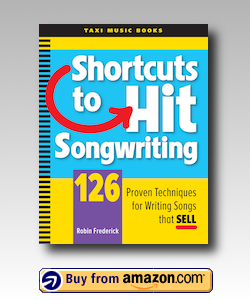
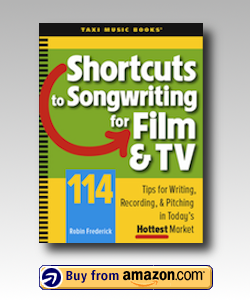
Shortcuts to Hit Songwriting Shortcuts to Songwriting for Film & TV


